There is a silent killer destroying the profitability of small and medium-sized enterprises across the globe. It is not poor product quality. It is not lack of traffic. It is the “Beautiful Brochure Website.” For over a decade, agencies have convinced business owners that aesthetic superiority—complex animations, massive video backgrounds, and abstract layouts—is the key to digital success.
In 2026, we must expose this for what it is: an expensive vanity project. When a prospective client clicks on your Google Ad or organic search result, they do not care about your designer’s artistic vision. They are experiencing a micro-moment of high intent. They have a specific problem, and they are ruthlessly scanning your page to determine if you possess the solution. If your landing page creates cognitive friction, delays their answer by even 1.5 seconds, or confuses their visual hierarchy, they will bounce to your competitor.
True digital architects operate differently. They do not view web design as an art form; they view it as an exercise in behavioral psychology and Conversion Rate Optimization (CRO). This masterclass deconstructs the exact, unvarnished frameworks that elite conversion engineers use to turn passive traffic into captured revenue—the very frameworks traditional graphic designers do not want you to know about, because it renders their complex, expensive visual flair obsolete.
Chapter 1: Hick’s Law and the Eradication of Choice Paralysis
If you want a landing page to convert, you must fundamentally misunderstand what a landing page actually is. It is not a homepage. A homepage is a directory, designed to let a user explore your entire brand ecosystem. A landing page is a specialized conversion trap. Its sole mathematical purpose is to force a single, highly specific action.
The Mathematics of Friction
In psychological design, we rely heavily on Hick’s Law, which states that the time it takes for a person to make a decision increases logarithmically as the number of choices increases. Traditional web designers ignore this. They will build a landing page and include a massive top navigation bar (Home, About, Services, Blog, Contact), a sidebar of recent news, and footer links to your social media.
Every single one of those links is an exit door. You are literally paying for Google Ads to bring traffic to a page, and then providing the user with 15 different ways to leave without converting. Elite conversion engineers practice Ruthless Essentialism. A high-converting landing page strips away the main navigation entirely. There is no footer menu. There is no sidebar. The user is presented with exactly two options: convert, or close the browser tab. This forced funneling can instantly double lead generation rates without spending an extra penny on traffic.
Stop Paying for Traffic That Doesn’t Convert
A beautiful website that doesn’t generate leads is just a digital expense. Transition to a revenue-generating asset engineered by conversion specialists.
Chapter 2: The “Above the Fold” Anatomy in 2026
The phrase “above the fold” originates from the newspaper industry—the content visible on the front page before it is unfolded. In web design, it refers to the digital real estate visible on a user’s screen before they touch the scroll wheel. You have exactly 2.5 seconds to establish trust and convey value in this space.
The Death of the Image Carousel
For years, designers loved placing rotating “sliders” or image carousels at the top of landing pages. They felt dynamic and allowed the business to cram five different messages into one space. Conversion data from 2026 proves that sliders are conversion suicide. They induce a phenomenon known as “Banner Blindness.” Users subconsciously identify moving, rotating graphics as advertisements and ignore them completely. Furthermore, they destroy mobile page load speeds.
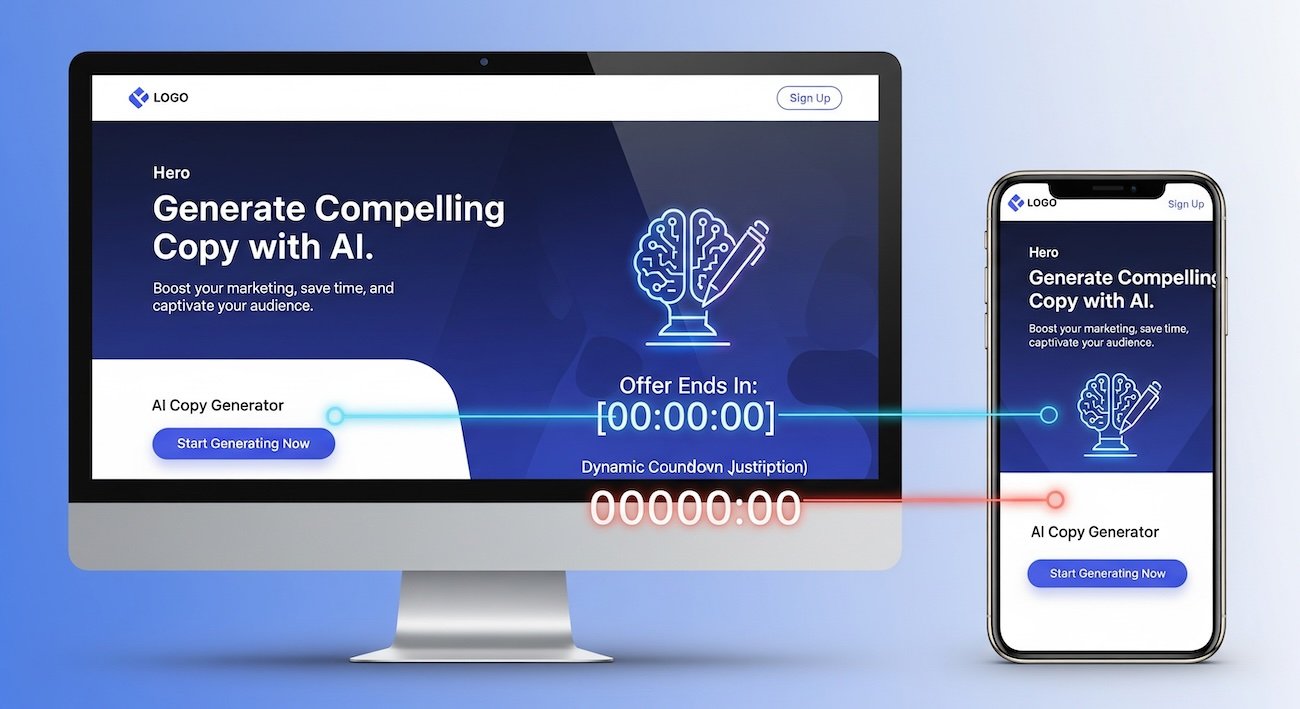
Instead, the elite standard is the Static Value Proposition Framework. This consists of four rigid elements that must never be altered:
- The Super-Headline (Eyebrow): A tiny, high-contrast tag sitting above the main text calling out the specific target audience (e.g., “For Commercial Property Managers in London:”).
- The H1 Value Proposition: This does not say “Welcome to Our Company.” It explicitly states the end-result you deliver (e.g., “We Eradicate Black Mold in 48 Hours. Guaranteed.”).
- The Sub-Headline (The ‘How’): A brief sentence supporting the H1, explaining the mechanism of your success to instantly build trust with your website design.
- The Primary & Ghost CTAs: A high-contrast primary button (“Get an Instant Quote”) immediately followed by a low-friction ghost button (“See How it Works” or a Video Play button).
Chapter 3: The Algorithmic Reality of Speed
There is a massive disconnect between graphic design and technical engineering. A designer will happily provide you with a stunning mock-up featuring 4K video backgrounds and complex scroll animations. What they don’t tell you is that to make that work, they have to inject massive amounts of JavaScript and DOM (Document Object Model) bloat.
In 2026, Google’s Core Web Vitals—specifically the Interaction to Next Paint (INP) metric—are ruthless. But beyond SEO, speed is the ultimate conversion lever. Amazon famously calculated that a page load slowdown of just 1 second could cost them $1.6 billion in sales. For a small business, a 3-second delay on a mobile 4G connection will result in a 53% bounce rate.
The “Friction Penalty”: Load Time vs. Mobile Conversion Rate
This is why utilizing free website builders for commercial landing pages is often catastrophic. Their chaotic background code throttles mobile CPUs. Conversion engineering requires native, brutalist code structures where visual flair is sacrificed for sub-second rendering.
Chapter 4: Micro-Copy and the Psychology of the Button
A web designer will style a button to match your brand colors and write “Submit” or “Contact Us” on it. A conversion copywriter knows that these two phrases create immense subconscious friction.
“Submit” implies yielding control. “Contact Us” implies work—the user knows they are about to be thrown into a generic email inbox and ignored. Elite landing pages utilize Value-Driven Micro-Copy. The text on the button must complete this sentence: “I want to…”
- Instead of “Submit”, use “Get My Free Assessment”
- Instead of “Contact Us”, use “Speak to an Engineer Now”
- Instead of “Subscribe”, use “Send Me the Case Study”
Furthermore, we surround these buttons with “Click Triggers”—tiny pieces of text directly below the CTA that remove final anxieties. (e.g., “No credit card required. Unsubscribe anytime.” or “Average response time: 14 minutes.”) These micro-interactions cost nothing to implement but systematically destroy user hesitation.
Chapter 5: The Matrix: Commodity Design vs. Conversion Engineering
To truly understand the “secret sauce,” you must learn to spot the difference between an agency selling you an aesthetic commodity, and an agency engineering a mathematical conversion system.
Audit Your Current Landing Page
Are you bleeding ad spend on a page that isn’t engineered to convert? Speak with our digital architects to identify and eliminate cognitive friction.
Executive Summary: The 2026 Mandate
The next time a web designer attempts to sell you a digital asset based purely on how “modern” or “sleek” the Figma mockups look, walk away. In the hyper-competitive 2026 digital landscape, aesthetic supremacy does not pay the bills. True commercial dominance requires stripping away the vanity metrics, embracing ruthless technical speed, and deploying aggressive psychological frameworks that respect the user’s intent. You do not need a piece of art; you need a machine.
The Master FAQ: Unvarnished CRO Truths
We scour global marketing communities and Reddit’s r/PPC and r/CRO forums to answer the gritty, high-stakes questions business owners ask when their ad budgets are bleeding out on bad landing pages.
Should my landing page be short and punchy, or a long-form sales letter?
It depends entirely on the “temperature” of your traffic and the price of your offer. If you are selling an impulse buy or capturing a lead for a free local quote (Warm Traffic / Low Risk), short and punchy above-the-fold design wins. If you are selling a £10,000 B2B software integration to cold traffic (High Risk), you need a massive, long-form page packed with logical arguments, risk-reversal guarantees, and extensive social proof to overcome skepticism.
My designer says we need a “minimalist” form. Is that always better?
Not if you are generating garbage leads. Asking for just a name and an email will maximize your volume, but it will ruin your sales team’s closing rate because the intent is too low. Using a multi-step form that asks 3 or 4 qualifying questions creates “micro-commitments.” The user invests time answering easy questions, making them psychologically more likely to submit their contact info at the end, resulting in far higher quality leads.
Are countdown timers and “scarcity” banners still effective in 2026?
Only if they are mathematically and verifiably true. Consumers have developed profound immunity to fake urgency (e.g., “This offer expires in 15 minutes!” every time you refresh the page). Fake scarcity instantly destroys trust and signals a scam. If you have a genuine capacity limit (e.g., “We only take 4 new roofing projects per month”), state that clearly. Authentic scarcity converts; fake scarcity repels.
Why does my mobile landing page have a massive bounce rate when desktop is fine?
Because your designer likely designed it for desktop and just let the responsive CSS “squish” it for mobile. On mobile, the “Thumb Zone” is critical. If your CTA button is tiny, or hidden inside a hamburger menu, or pushed way down the screen by a massive header image, you are creating massive friction. Mobile landing pages require sticky headers with persistent click-to-call vectors anchored to the bottom of the screen.
A high-converting landing page is only half the job — it needs to sit on a fast, credible domain. See our small business web design services to get both right.
The best landing page in the world converts nothing without the right traffic arriving at it. Our affordable SEO services for small businesses are built to send qualified visitors to pages like these.